Veitchia vitiensis
Veitchia vitiensis
Veitchia vitiensis
Palma
Vedi altre varietà simili in stock
Vedi tutti →
Disponibile in 1 taglie
Disponibile in 5 taglie
Disponibile in 4 taglie
Disponibile in 2 taglie
Disponibile in 6 taglie
Disponibile in 1 taglie
Disponibile in 1 taglie
Disponibile in 1 taglie
Disponibile in 1 taglie
Disponibile in 2 taglie
24 mesi garanzia di permuta su questa pianta
Altre informazioni
Garantiamo la qualità delle nostre piante per un intero ciclo di crescita e sostituiremo a nostre spese qualsiasi pianta che non si riprenda nelle normali condizioni climatiche e di impianto.
Questa pianta è adatta al mio giardino?
Creo il mio profilo Plantfit →
Descrizione del prodotto
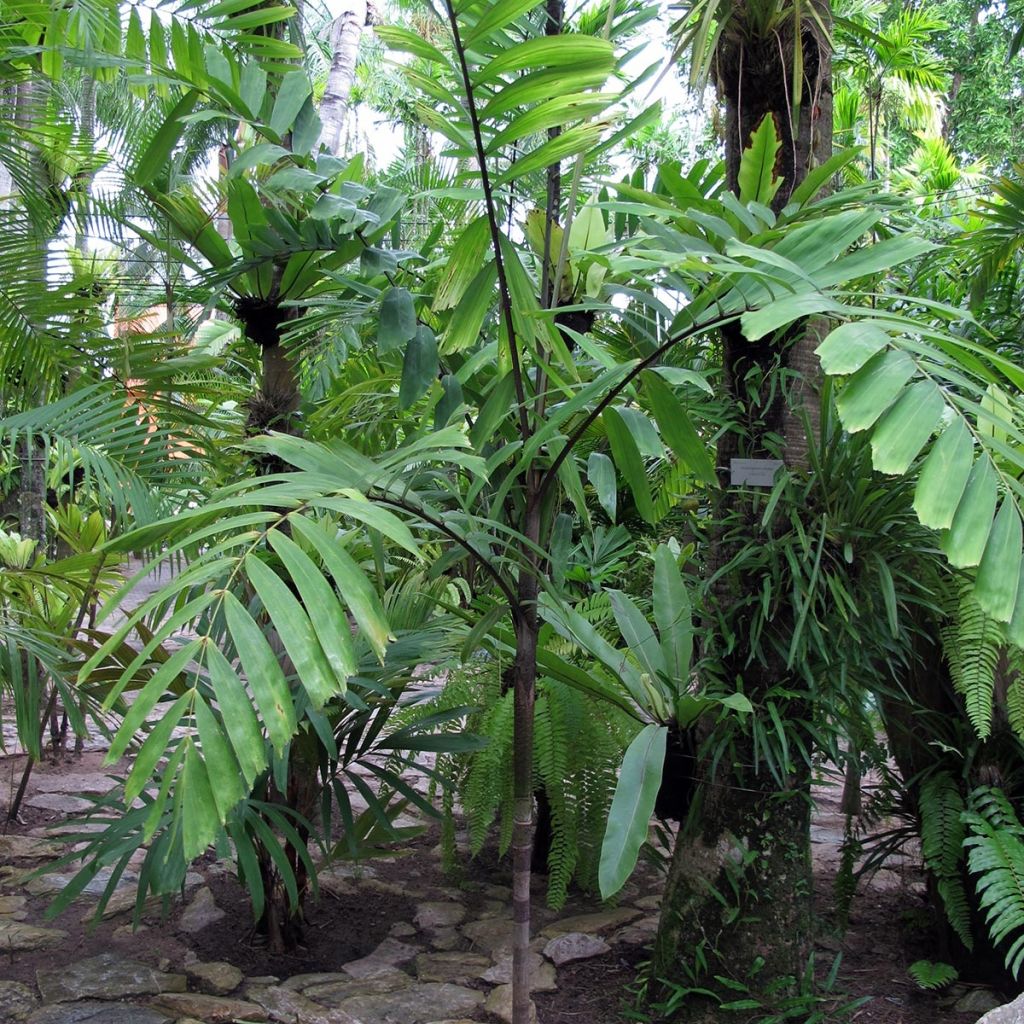
The Veitchia vitiensis is a delightful rare Fijian palm tree, certainly tropical in temperament, but quite easy to grow in a veranda, a greenhouse, or a very bright interior. This slender species is characterized by a particularly thin false trunk and a crown of large, semi-erect, and pinnate aerial leaves. Not hardy, it is grown in a container or a large pot, which allows it to be protected from the cold in winter. This species likes fresh, rich, and light soils as well as a semi-shady exposure.
The Veitchia vitiensis belongs to the Arecaceae family. It is native to the Fiji Islands in the southwest Pacific Ocean, where it grows in small populations in primary forests, often on hill slopes. This species of humid tropical climate perishes below 0°C, but adapts well to indoor cultivation as long as winter temperatures range between 10 and 15 °C and the atmosphere remains humid. Young plants take a little time to establish themselves, then growth accelerates a bit. When planted in the ground, Veitchia vitiensis can reach a height of 12 to 15 m, but it will not exceed 3 m in height by 1.50 m in width if grown in a container indoors or in a greenhouse.
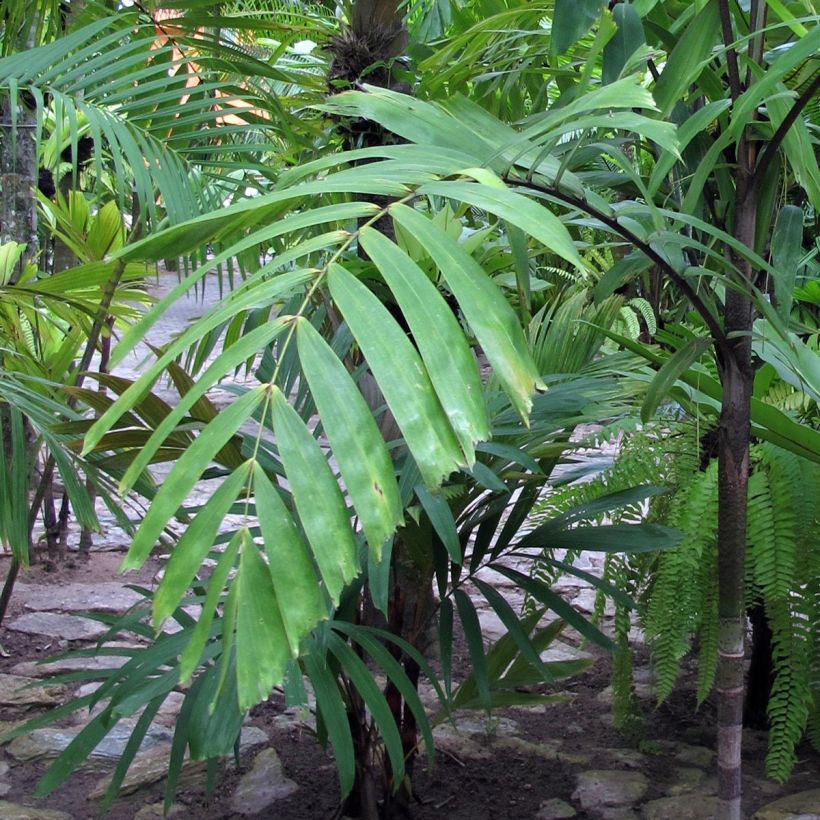
This Palm tree develops a single trunk, called a stipe, very thin and tapered (25 cm in diameter at the base, but 4 to 5 cm in diameter under the leaves), gray in color, strongly ringed with prominent leaf scars. At the top of this stipe, a beautiful, sparsely dense leaf crown develops. It consists of 8 to 10 large, slightly arched pinnate leaves, reaching 3 m in length. The leaf is divided into 30 to 40 pairs of lanceolate, rather wide leaflets, arranged almost horizontally. Their color is a bright green. The petiole that carries each leaf is short, pubescent, and brown in color. Flowering occurs in summer, on mature plants aged 10 to 15 years, and under favorable growing conditions. The inflorescences emerge under the leaves. They are erect and branched. Each one bears both male and female flowers, whitish-green in color. The fruit is rounded to ellipsoid, measuring up to 19 mm in length.
The Veitchia vitiensis, with its neat appearance of a small palm tree, will make a statement in the veranda, tropical greenhouse, or a very bright room. It thrives well in containers and can be taken out to the terrace or balcony from May to September, after an acclimatization period. Like all palm trees, it is difficult to pair with other plants due to its strong personality: reserve a corner by a pool or a prominent spot on the terrace, initially exposing it to shade so it gradually gets used to the sun. Surround it with Phormium, graphic, sober, and colourful, with agaves precise and geometric, or even with Cordyline for example.
Segnala un errore nella descrizione del prodotto
Veitchia vitiensis in foto...
Porto
Fioritura
Fogliame
Piantagione e cura
This Veitchia vitiensis palm is a frost-sensitive tropical plant that thrives in warm and humid environments and perishes below 0°C. It adapts well to container or large pot cultivation. Young plants are sensitive to direct sunlight, while adult specimens tolerate it better, preferring dappled sunlight. It thrives in non-calcareous (neutral to acidic), humus-rich, light, fertile soils that remain moist throughout the growing season, from spring to autumn. In winter, watering should be slightly reduced, but the growing medium should never completely dry out. It requires minimal maintenance, except for trimming the oldest palm fronds if necessary.
Container cultivation:
Choose a large pot or container with drainage holes, with a capacity of 40 litres. Prepare a mixture consisting of 25% heather soil, 50% compost or humus, and 25% sand. Add some crushed horn. Mix well. Partially fill your container, after placing a drainage layer at the bottom (clay balls, gravel, broken terracotta pots...). Position your palm in the mixture, ensuring that the root collar is level with the pot rim but not buried too deep. Add the rest of the mixture around the root ball, firming it down. Water in stages to thoroughly saturate the growing medium and eliminate air pockets.
Place your palm in a very bright location, avoiding harsh sunlight (not behind a window or glass door). During winter, the optimal temperature in the greenhouse or conservatory should be between 10 and 15°C. Regularly mist the foliage to combat dry air. Clean the leaves with a sponge to remove dust. Initially, position it outdoors in shade, then in partial shade to protect the foliage. After two weeks in partial shade, gradually expose it to sunlight. Provide complete liquid fertiliser for green plants once a month, from March to August.
Quando piantare?
Per quale località?
Trattamenti
Questo articolo non è ancora stato recensito; sii il primo a condividere la tua esperienza.
Prodotti visualizzati di recente
Non hai trovato quello che cercavi?
La rusticità è la temperatura invernale più bassa che una pianta può sopportare senza subire gravi danni o addirittura morire. Tuttavia, la rusticità è influenzata dalla posizione (zona riparata, come un patio), dalla protezione (copertura invernale) e dal tipo di terreno (la rusticità è migliorata da un terreno ben drenato).
I periodi di semina indicati sul nostro sito web si riferiscono a Paesi e regioni all'interno della Zona USDA 8 (Francia, Regno Unito, Irlanda, Paesi Bassi).
Nelle zone più fredde (Scandinavia, Polonia, Austria...), ritardare le semine all'aperto di 3-4 settimane o seminare sotto vetro.
Nei climi più caldi (Italia, Spagna, Grecia, ecc.), anticipare la semina all'aperto di qualche settimana.
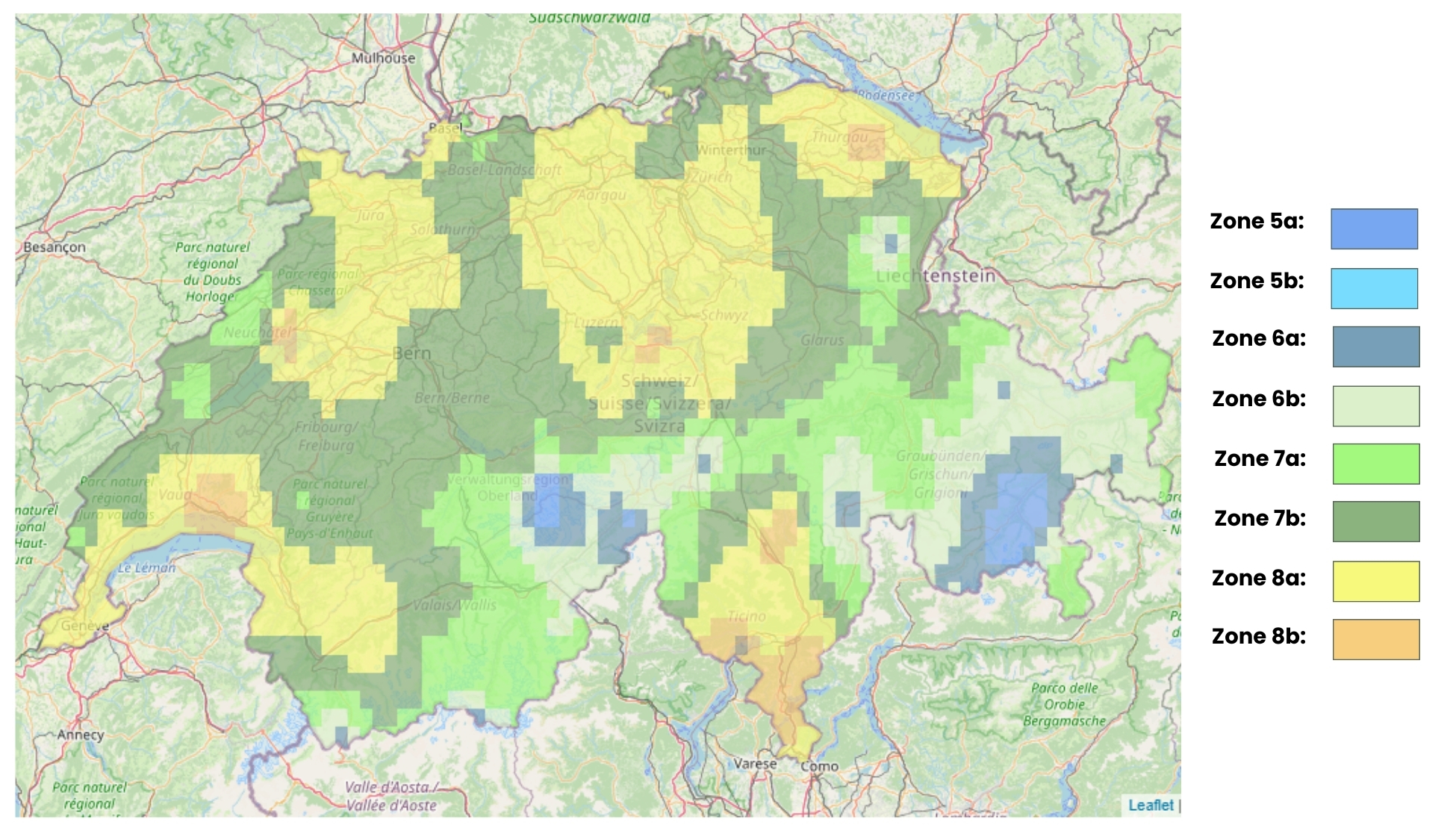
Il periodo di fioritura indicato sul nostro sito web si riferisce alle regioni situate nelle zone USDA 7b–8a (Altopiano centrale e Arco del Lemano: Zurigo, Berna, Basilea, Losanna, Ginevra).
Esso varierà a seconda del luogo di residenza:
- In Ticino e nelle valli meridionali (Lugano, Locarno, Bellinzona, Mendrisio), la fioritura sarà anticipata di 2-4 settimane rispetto alle date indicate, grazie a una marcata influenza mediterranea che mitiga gli inverni e rende le primavere particolarmente precoci.
- Nelle Alpi e nelle Prealpi (Davos, St. Moritz, Zermatt, Interlaken, Coira), la fioritura sarà ritardata di 4-6 settimane. Avverrà principalmente tra giugno e agosto a seconda dell'altitudine.
Il periodo di piantagione indicato sul nostro sito web si applica alle regioni situate nelle zone USDA 7b–8a (Altopiano centrale e Arco del Lemano: Zurigo, Berna, Basilea, Losanna, Ginevra). Esso varia a seconda del luogo di residenza:
- In Ticino e nelle valli meridionali (Lugano, Locarno, Bellinzona, Mendrisio), è preferibile piantare in autunno (ottobre–novembre) o alla fine dell'inverno (febbraio–marzo), evitando i mesi estivi in cui il caldo e la siccità possono costituire un rischio per le piantagioni recenti.
- Nelle Alpi e nelle Prealpi (Davos, Saint-Moritz, Zermatt, Interlaken, Coira), è preferibile piantare in tarda primavera (maggio-giugno), una volta scongiurato il rischio di gelate tardive, oppure in fine estate (agosto), prima che le gelate precoci si verifichino già a settembre in altitudine.
Il periodo di raccolta indicato sul nostro sito web si riferisce ai Paesi e alle regioni della zona USDA 8 (Francia, Inghilterra, Irlanda, Paesi Bassi).
Nelle zone più fredde (Scandinavia, Polonia, Austria...) la raccolta di frutta e verdura potrebbe essere ritardata di 3-4 settimane.
Nelle zone più calde (Italia, Spagna, Grecia, ecc.), la raccolta avverrà probabilmente prima, a seconda delle condizioni meteorologiche.
Nei climi temperati, la potatura degli arbusti a fioritura primaverile (forsizia, spiree, ecc.) deve essere effettuata subito dopo la fioritura.
La potatura degli arbusti a fioritura estiva (lillà indiano, perovskia, ecc.) può essere effettuata in inverno o in primavera.
Nelle regioni fredde e con piante sensibili al gelo, evitate di potare troppo presto quando possono ancora verificarsi forti gelate.
Paese di consegna e lingua
La tua posizione sembra essere:
La tua posizione è:
Per godere della migliore esperienza sul nostro sito, è possibile cambiare:
Paese di consegna:
-
 Austria
-
 Belgio
-
 Bosnia ed Erzegovina
-
 Bulgaria
-
 Cechia
-
 Cipro
Cipro
-
 Croazia
-
 Danimarca
-
 Estonia
-
 Finlandia
-
 Francia
-
 Germania
-
 Grecia
-
 Irlanda
-
 Islanda
-
 Italia
-
 Lettonia
-
 Liechtenstein
-
 Lituania
-
 Lussemburgo
-
 Malta
Malta
-
 Paesi Bassi
-
 Polonia
-
 Portogallo
-
 Romania
-
 Serbia
-
 Slovacchia
-
 Slovenia
-
 Spagna
-
 Svezia
-
 Svizzera
-
 Ungheria
Lingua:
-
Francese
-
 Inglese
-
Spagnolo
-
Italiano
-
Tedesco
-
Portoghese
-
Olandese
-
Finlandese
Il mio account
Salve
I miei elenchi di preferiti
Il mio carrello
Accesso / Registrazione
Sei già cliente?
Questo modulo è protetto da reCAPTCHA - si applicano l'informativa sulla privacy e i termini di servizio.
Non sei ancora cliente?
Crea il tuo account per poter seguire il tuo ordine, accedere al nostro servizio clienti e, se lo desideri, approfittare delle nostre prossime offerte.